Interval funds have moved from niche products to strategic priority as managers look beyond traditional institutional channels and toward retail and wealth-management capital. In a more difficult fundraising environment, they offer access to private credit, real estate debt, infrastructure, and other less-liquid strategies through a registered fund structure that provides periodic liquidity rather than daily redemption.
Structurally, interval funds sit between open-ended mutual funds and traditional closed-end funds. They are typically continuously offered at net asset value, but unlike mutual funds they do not provide daily liquidity. Under Rule 23c-3, they make repurchase offers at fixed intervals, generally every three, six, or twelve months, and in amounts between 5% and 25% of outstanding shares. If repurchase requests exceed the offer amount, tenders are generally accepted on a pro rata basis.
A central challenge is that the fund offers liquidity on a predetermined schedule while the underlying assets may be difficult to value, difficult to sell, or both. This makes liquidity management, valuation governance, service-provider coordination, and board oversight core elements of the operating model.
Long-term resilience in an interval fund depends on effective liquidity planning, sound repurchase mechanics, disciplined valuation, fair allocation practices, reliable operational execution, and strong governance.
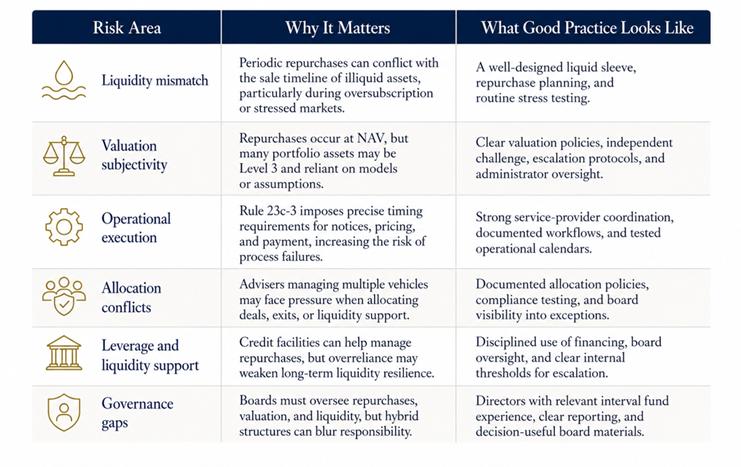
The interval fund operating model must manage repurchase obligations while supporting fair valuation and resilient execution.
Interval fund risk management is shaped by a central tension: the fund offers periodic liquidity even though a meaningful portion of the portfolio may be illiquid, difficult to value, or both. Managing this tension requires an integrated framework across liquidity, valuation, operations, compliance, and governance.
Rule 23c-3 permits repurchase offers only at fixed intervals and within a defined range of 5% to 25% of outstanding shares. The board sets the offer amount. Shareholders receive advance notice of each offer, and the fund must be ready to meet repurchases on the required timeline. Funds operating at the minimum repurchase level may remain technically compliant while failing to meet investor expectations.
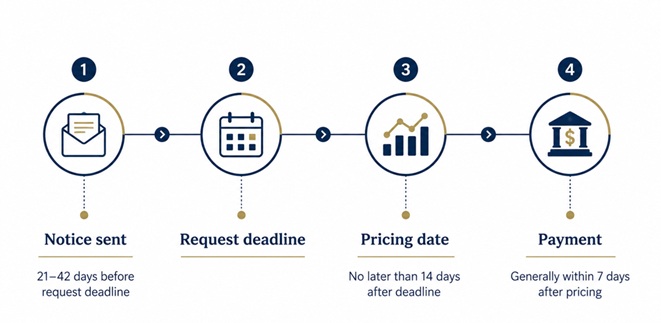
Repurchase offers are operationally complex. Notice typically must be sent 21 to 42 days before the request deadline. The pricing date must occur no later than 14 days after that deadline. Payment generally must be made within seven days after pricing. Proper coordination among the fund, administrator, transfer agent, and counsel is essential.
Many interval funds invest in Level 3 assets without observable market prices. NAV may therefore rely on discounted cash flow models, comparable-company analyses, appraisals, or manager-developed assumptions. Because repurchases occur at NAV, weak valuation practices affect both redeeming and remaining shareholders.
Stress can arise not only through oversubscription but also through excess cash drag, reliance on credit facilities, forced asset sales at unattractive prices, or an overly thin liquid sleeve that fails under stress.
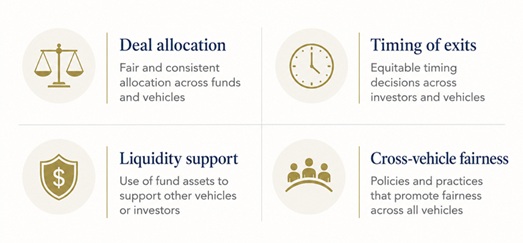
As interval funds expand across private-market strategies, fairness, flexibility, and oversight become central to the structure.
When an adviser manages interval funds alongside private funds, separately managed accounts, business development companies, or affiliated vehicles, overlapping mandates can create tension around deal allocation, liquidity support, and the timing of exits. Fair, consistently applied allocation procedures supported by compliance testing are essential.
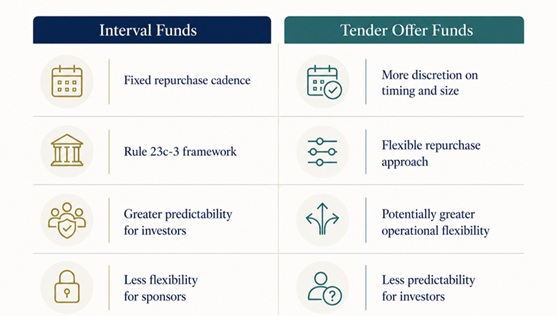
Interval funds are often compared with tender offer funds because both are unlisted closed-end structures used for less-liquid assets. The key difference is that interval funds commit to a fixed repurchase cadence under Rule 23c-3, while tender offer funds generally have more discretion over timing and size of repurchases.
From an oversight perspective, the goal is not only to document policies, but to ensure that allocation, liquidity, and product-design decisions remain fair, explainable, and durable under stress.
Boards, operating discipline, and practical infrastructure determine whether the structure can withstand stress and scrutiny over time.
Independent directors play a critical oversight role in interval funds. They set repurchase offer amounts, oversee liquidity management, monitor valuation processes, and assess whether the operating model remains appropriate as the fund grows. This is especially important when the fund has a complex manager-wrapper arrangement, uses leverage to support liquidity, or relies heavily on third parties.
Predictability can support investor confidence, but flexibility can support resilience. The operating model must be designed with that trade-off in mind.
Strong interval fund risk frameworks typically include routine liquidity stress testing, robust valuation governance, institutional-quality service providers, disciplined cash controls, documented allocation policies, and clear investor disclosures about liquidity limits and repurchase outcomes. For sponsors, boards, allocators, and platforms evaluating interval funds, the central question is whether the operating model, governance framework, and control environment can properly support the structure, especially when liquidity conditions deteriorate.
Get our latest updates and investment manager performance reports