
By Luke Mandekic, Co-Head of Distribution at Channel Capital
For decades, the standard investment formula felt reassuringly familiar. A diversified mix of public equities for growth, bonds for regular income and portfolio protection, and some listed property and corporate credit for yield enhancement and diversification – a formula you could build a client conversation around with confidence. It worked, and for a long time it worked well. But that same formula is now facing its most significant stress test, and many of the advisers we speak with are quietly asking whether the toolkit should be expanded.
As the post-COVID market environment continues to unfold, the 60/40 portfolio bedrock has faced a complex and nuanced cycle test – one that many advisers have not encountered in their careers in quite this form. The regime shift of sticky inflation and the prospect of sustained higher interest rates, alongside a new age of widespread technological innovation and disruption, has quietly but fundamentally disrupted the assumptions that underpinned that model for a generation. In this climate, global private equity has proven to be a highly valuable portfolio diversifier and source of outsized returns. For advisers seeking returns that are structurally differentiated and uncoupled from the daily volatility of public market sentiment, the case has never been more compelling.
Understanding why private equity behaves differently from public markets is where the conversation with clients often begins, and it is one worth having with confidence.
In the short term, public equity pricing tends to be driven by sentiment and broad technical movements, the kind of noise that has little bearing on the underlying value of a business. Private equity, by contrast, seeks to generate what is often referred to as operational alpha – returns driven by long-term strategic repositioning, margin expansion, and fundamental growth at the individual company level. It is a different kind of ownership, with a different kind of discipline.
In the current environment, this distinction is increasingly important. The global transition away from near zero interest rate monetary policies has placed a significant premium on quality, creating a sharp and unforgiving divide between resilient businesses with durable cash flows and those that previously relied on inexpensive leverage to mask weak fundamentals.
What this means in practice is that alpha in private equity is no longer a product of financial engineering or clever cycle timing. It is created through active ownership, the ability and commitment to build more productive, more competitive businesses over time. For advisers, this is a fundamentally different and more grounded value proposition to present to clients, one rooted in business quality and stewardship rather than market sentiment.
Linked to this, we are witnessing an overwhelming shift in the preferences of advisers and investors. Capital allocation continues to move toward more of an endowment style model where there is less emphasis on short term performance relative to public markets, and instead, the focus is on sustainable long-term value creation.
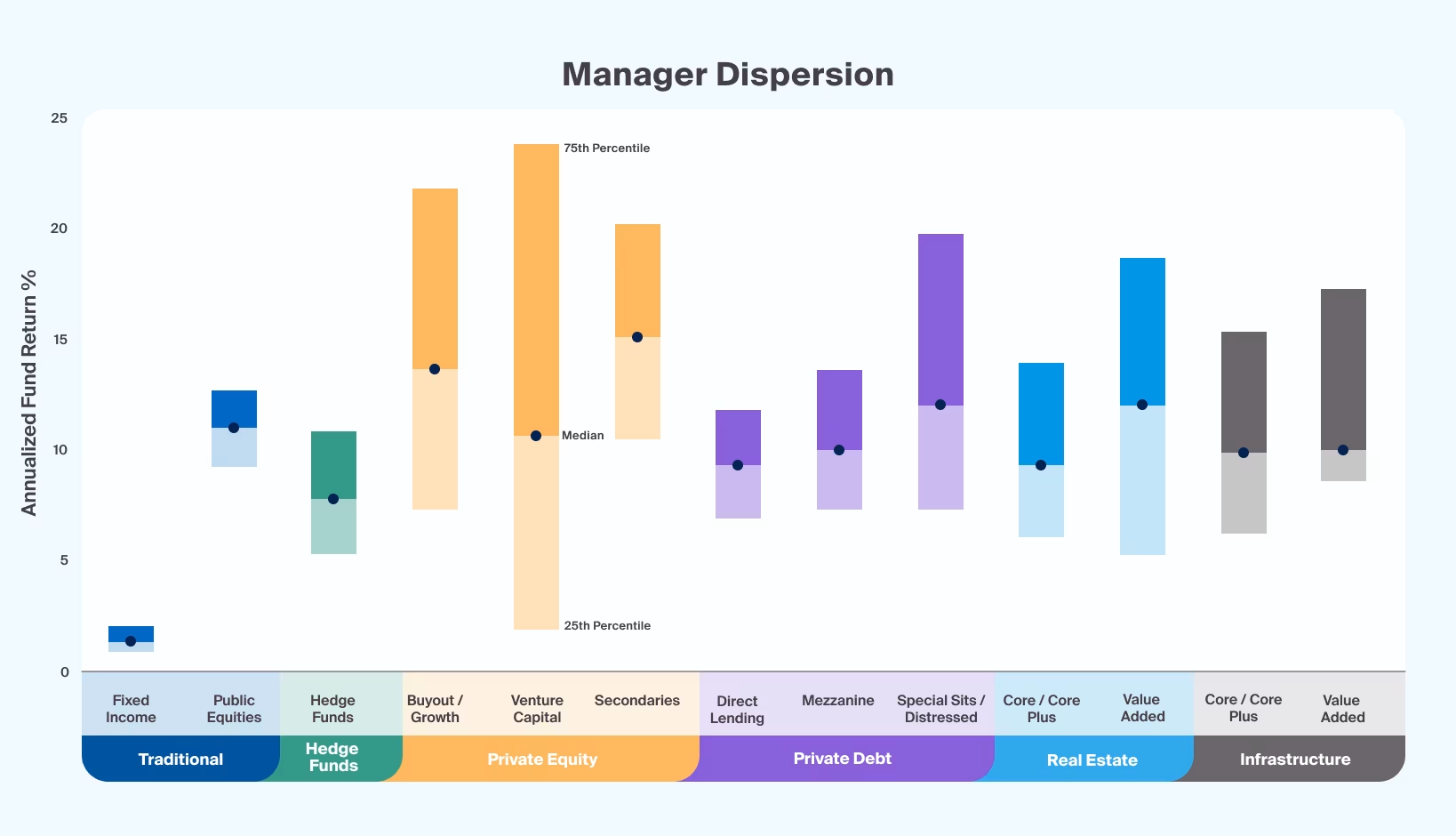
Where indexing is a common theme in public equities, global private equity requires a fundamentally different mindset. The median return in this asset class is often misleading because the dispersion of net returns between top-quartile and bottom-quartile managers is remarkably wide, far exceeding the gaps seen in listed markets. This dispersion exists because private equity outcomes are not evenly distributed, they are directly bound to a manager’s specific ability to underwrite risk and execute a value-creation plan.
Image: Performance Dispersion Across Private Equity and other Asset Classes (Top vs. Bottom Quartile)
Investing in private equity is an exercise in human judgement and investment discipline. Unlike public markets, where an index can do much of the work, private equity is highly idiosyncratic in nature, and the quality of the team behind the strategy matters enormously.
When you allocate to private equity, you are not simply buying an investment strategy. You are backing an investment team's behaviour – their discipline under pressure, their ability to stay the course during periods of volatility, and their capacity to make clear-headed decisions when the environment is anything but. That is a fundamentally different kind of due diligence, and one that rewards those who take it seriously.
The critical differentiator is the "who." Experienced teams with repeatable, well-tested processes who have navigated multiple market cycles and maintained the operational expertise to partner meaningfully with management teams throughout are not easy to find. But they are worth looking for. Identifying and accessing those teams is where the real value of thoughtful manager selection lies.
The narrative advisers should focus on with their clients when discussing private equity is the concept of alpha transition from passive ownership to an industrialised process of business transformation. When discussing these strategies, the key is to emphasise how an embedded team of operational experts acts for a company’s existing management. This helps the client view the allocation not as a static bet on a particular sector, but as an investment in a repeatable discipline, one that actively focuses on technology, talent, and strategy from day one.
As an example, the commitment of some private equity firms to broad-based employee ownership provides a tangible "cultural hedge" that embeds a value creation mindset at all levels of a business. By encouraging equity participation through every level of an organisation, the aim is to create a structural alignment of interests with the firm institutionalising a culture of performance an resilience. This translates to a more agile company where every stakeholder is incentivised to drive long-term capital growth. By framing the strategy as a synthesis of expert-led operational improvement and stakeholder alignment, advisers can confidently explain why this active approach is a necessary driver of sustainable net returns.
One of the most significant shifts in private equity over recent years has nothing to do with markets or valuations – it is about access. Historically, private equity was the exclusive domain of large institutions due to the constraints of long lock-up periods, unpredictable capital calls, and large investment minimums. That has changed.
The rise of evergreen or open-ended fund structures has effectively lowered these entry barriers. These vehicles allow for ongoing subscriptions and offer periodic liquidity within a framework that remains continuously invested across multiple vintages (capital is spread across investments made in different years). For Australian wholesale investors, this provides a more flexible gateway to institutional-grade global private equity strategies, without sacrificing the rigour of professional underwriting or the benefits of long-term ownership that make the asset class so attractive in the first place.
In short, the structural barriers that once made private equity inaccessible to adviser-led portfolios have been meaningfully reduced. The conversation has moved from "can my clients access this?" to "how do I size it appropriately?"
For advisers, the practical implications are significant. Evergreen structures are designed to offer:
“ In an asset class where the time taken to get invested can often be elongated, evergreen global private equity funds can help solve the deployment challenge by providing investors with immediate exposure. These vehicles can provide the opportunity to start compounding wealth alongside the world’s largest institutions from day one”.
While geopolitical tensions and global volatility have often caused apprehension, history continues to suggest that macroeconomic complexity frequently creates the most fertile ground for investment. Global private equity is uniquely positioned to potentially outperform during these periods because capital is patient, the investment outlook is long-term, and the discipline to look through the noise are not just philosophical virtues, they are structural advantages. Over the next decade, global private equity could be poised to be a leading asset class for those who prioritise intrinsic value over market sentiment.
That means an unwavering focus on resilience – businesses with durable cash flows, significant pricing power, and strong competitive positions that do not rely on leverage or multiple expansion to deliver returns. When the easy drivers of growth are no longer available, value must be built from within through productivity gains, strategic repositioning and the kind of hands-on operational partnership that quality private equity managers are renowned for.
Perhaps the most important lens through which to consider this opportunity is the changing nature of where growth actually happens. The public market universe is shrinking. Companies are staying private for longer. The most dynamic phases of a business’s life cycle (the years of real transformation, expansion and value creation) are now occurring almost exclusively outside of public market exchanges.
Access to global private equity is, in this sense, access to the real economy to businesses being actively shaped and strengthened by experienced stewards with a long-term mandate. While market cycles fluctuate, the fundamental discipline of identifying quality and building stronger businesses remains the most enduring and reliable driver of long-term wealth creation.
This information has been prepared by Channel Investment Management Limited (ACN 163 234 240) (AFSL 439007) (’CIML’). This article has been prepared and provided for informational purposes only. No representation or warranty, express or implied, is made as to the accuracy, reliability, or completeness of the information contained in this article, and nothing in this article should be relied upon as a promise or representation.
Neither CIML, nor any of its directors, officers, representatives, employees, associates, or agents, makes any representation or warranty as to the accuracy, reliability, timeliness, or completeness of the information contained in this article. To the maximum extent permitted by law, CIML and each of the above parties disclaim all liability (except for any liability which by law cannot be excluded) for any error, omission, inaccuracy, or misstatement, or for any loss or damage suffered by any person, directly or indirectly, arising from the use of, reliance on, or any action taken based on the information contained in this article. The information is not personal financial product advice and has been prepared without taking into account the objectives, financial situation or needs of any particular person.
Get our latest updates and investment manager performance reports